Railroads are a lot like electricity, Wi-Fi, and the coworker who always remembers to refill the office coffee pot—we rarely appreciate them until something goes wrong. As the students of this summer’s MGMT 775 Strategic Analysis and Application of Innovation (SAAI) course at the University of South Carolina (USC) learned, most of us hardly give a passing thought to trains until we find ourselves late to an appointment because we were stuck behind the blinking red lights of a railway crossing guard.

The students of this summer’s SAAI cohort had a unique learning opportunity that afforded them a new perspective to consider about railroads and trains, other than the graffiti art on the never-ending string of passing train cars. The course was led by SC Innovates’ own Kevin Diana, M.B.A. and offered by the Darla Moore School of Business through the SC Innovates® SmartState® Center. Each year, the course partners with a different USC technology laboratory to provide students with experiential coursework that puts them face-to-face with real technology and real business challenges. This summer, that technology partner was Insight Rail, LLC – a startup spun-out of one such lab that offered student teams to propose strategic plans to bring its technology to market.
The class worked on a personal level with Brennan L. Gedney, Ph.D., Chief Technical Officer of Insight Rail, LLC, to explore commercialization opportunities for Insight Rail’s RNT InterceptorTM. The technology has its own roots at the University of South Carolina, where it was developed as a research project within the Molinaroli College of Engineering and Computing with support from Federal Railroad Administration grants and industry partners such as CSX. The RNT Interceptor is a deformation-based mobile inspection system designed to estimate Rail Neutral Temperature (RNT) of a railway track. Compressive forces build in the steel rails as the tracks heat up from solar radiation, risking dangerous buckling or breaks that can cause costly derailments. Seasonal temperature swings further elevate this risk, making RNT estimation an important indicator of a track’s susceptibility to temperature-induced failures. The technology aims to help railroads better identify and manage these risks.
“I came into MGMT 775 knowing exactly two things about railroads: trains are long, and they run on tracks,” smiled Chandler Orr, a PMBA student at USC who says MGMT 775 offers quite the unique experience. “During the class, we were given the fun challenge to design a business plan for a new technology in an industry I knew next to nothing about! At the end of the course, I left with the knowledge of how to put together a full commercialization strategy for a new technology that measures stress in steel rail. Somewhere in between all that, I became the guy who points at track from the car and says something about thermal expansion,” chuckled Orr.
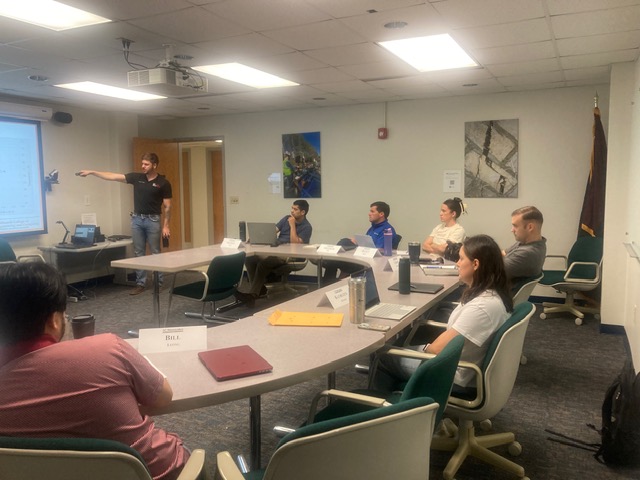
Orr’s perception is precisely the point of MGMT 775. According to Professor Diana, some of the course’s greatest value comes, not from simply studying a technology, but from bringing people with different backgrounds together to figure out how it can be used to solve real problems.
“SAAI offers a reminder that the learning process remains remarkably human, even within our increasingly technology-driven world,” stated Diana. “When a room is filled with smart people from a variety of smart backgrounds and those individuals are given an opportunity to question, challenge, and learn from one another in real time, the outcome is new insights and perspectives drawn into the light. Watching this unfold is one of the things I love most about teaching this course.”
Gedney knows that firsthand, too, which is why he approached the Center’s Director, Laura B. Cardinal, Ph.D., to partner with one another. Before becoming SAAI’s technology partner for this summer’s semester, Gedney himself was a student in MGMT 733, Strategic Management of Technology and Innovation (SMTI). SMTI is another of the Center’s courses that encompasses a similar discussion-centric learning approach driven by classmates who are all from a variety of different disciplines.
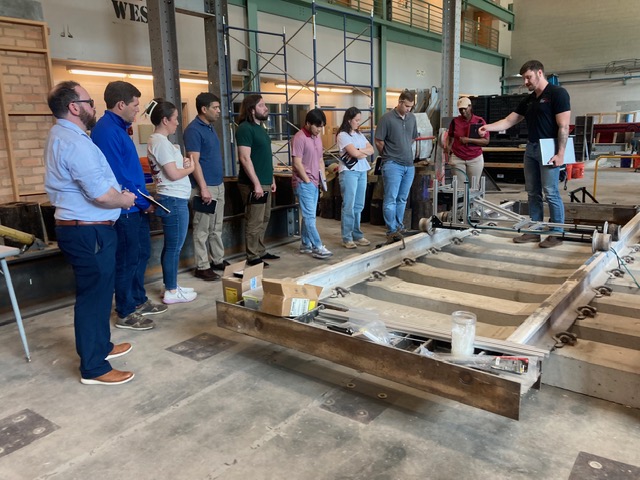
“It’s extremely fulfilling (and also fun) to come full circle from student to technology partner,” remarked Gedney. “The students really took a deep dive into the rail industry and market, and I couldn’t help but reflect on my own experience as I watched their collaboration take place. It just shows how much stronger an idea can become when people from different disciplines approach the same problem from different viewpoints.”
Those viewpoints were from students with backgrounds in business, education, biology, computer science, and even aerospace manufacturing. Beyond academic backgrounds, students also came from a variety of cities to obtain the unique and intangible aspect of this course’s collaboration. Students traveled from as far as Atlanta and Richmond Hill, Georgia, to attend two in-person Saturday sessions and one virtual Saturday session, with weekly team meetings online throughout the semester. “Talk about a variety of perspectives!” smiled Diana. “Perhaps the biggest takeaway from this summer’s course is that some of our most foundational industries, and even our best ideas, can hide in plain sight at times. When we stop long enough to notice, we can gain a deeper appreciation of the world around us and maybe, if we listen to others from different walks of life, we might even learn something new.”